
How to say THE in Spanish
In English THE is a definite article – It refers to something specific.
- I need the book. (It is a specific book, one that we both know about)
In English, there is only one form of definite article … THE
However in Spanish there is more than one form of definite article. There is EL, LA, LOS, and LAS.
So, what is the difference?
The article that is used in Spanish depends on the noun (noun = the name of something). As we have already seen in the previous lesson, Spanish nouns are either masculine or feminine. They can also have a singular or plural form.
Articles in Spanish need to match the gender and number of the noun:
- the gender (is the noun masculine or feminine?) and
- the number (is the noun singular or plural?)
In this lesson we are going to look at singular nouns and the definite article we use before them.
Definite Article with Singular Masculine Nouns in Spanish
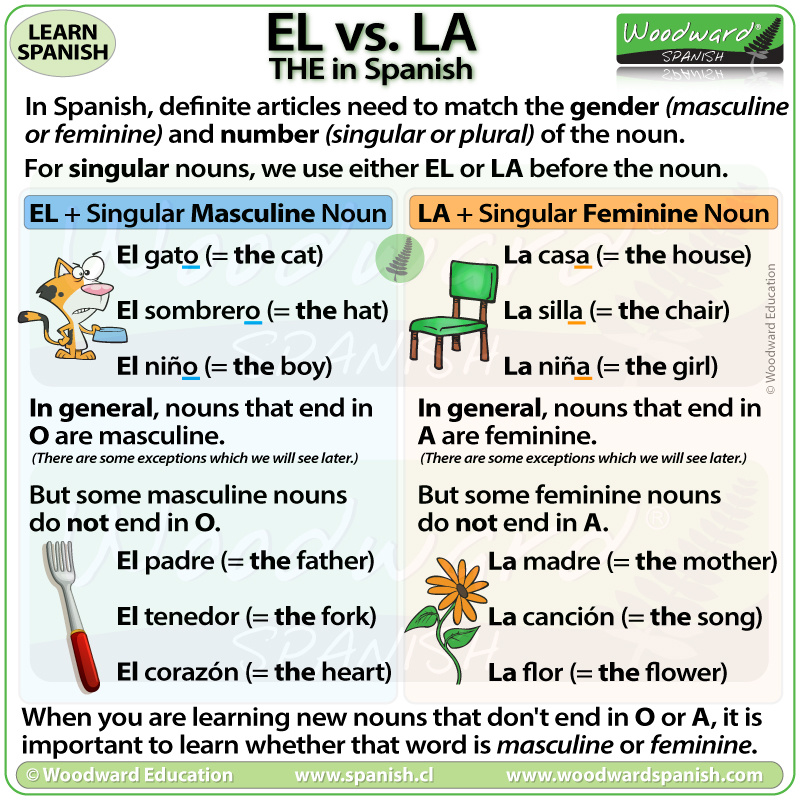
If a singular noun is masculine then we use the definite article EL before it.
- El libro (= the book)
- El sombrero (= the hat)
- El niño (= the boy)
Notice how these masculine nouns end in O. Libro, teléfono, niño.
In general, nouns that end in O are masculine. (There are some exceptions which we will see later.)
But there are also some masculine nouns that do not end in O.
- El padre (= the father)
- El tenedor (= the fork)
- El corazón (= the heart)
When you are learning new nouns that don’t end in O or A, it is also important to learn whether that word is masculine or feminine.
Definite Article with Singular Feminine Nouns in Spanish
If a singular noun is feminine then we use the definite article LA before it.
- La casa (= the house)
- La ventana (= the window)
- La niña (= the girl)
Notice how these feminine nouns end in A. Casa, escuela, niña.
In general, nouns that end in A are feminine. (There are some exceptions which we will see later.)
But there are also some feminine nouns that do not end in A.
- La madre (= the mother)
- La universidad (= the university)
- La flor (= the flower)
Note: There are a few masculine nouns that are irregular because they end in -A. These are exceptions and we will see these in another lesson.
Spanish EL vs. LA Chart
Spanish Definite Articles Practice Exercises
Here you can practice using EL and LA with 101 nouns: